
Agentic Commerce: How to Optimize Your Storefront for Autonomous AI Shoppers
The era of optimizing exclusively for human buyers is over. Discover how to transition your e-commerce site for Agentic Commerce using LLMO, llms.txt, MCP, and deep schema to capture the autonomous AI shopper.
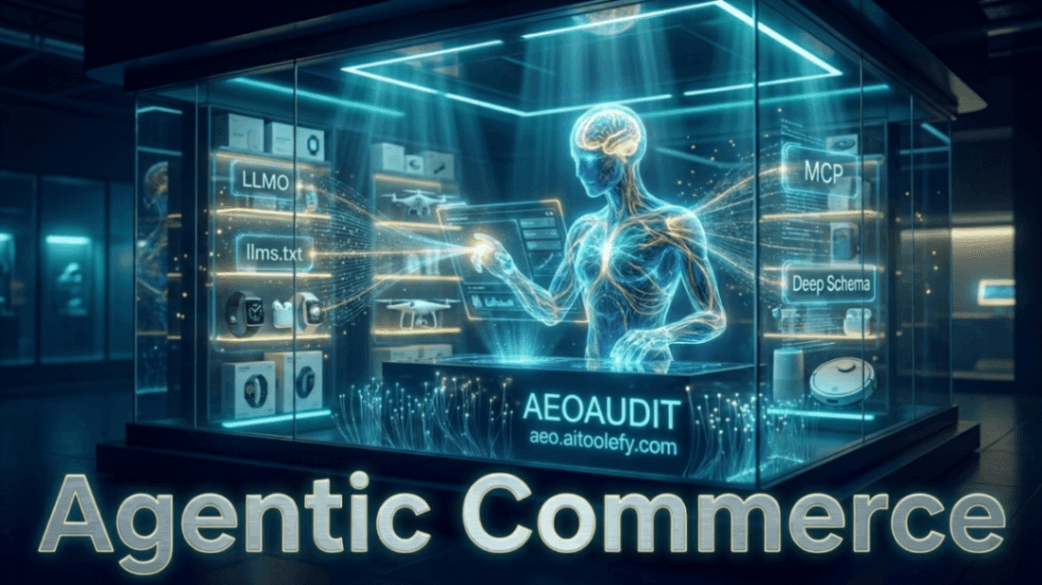
E-commerce is currently undergoing its most violent architectural shift since the invention of the digital shopping cart. For two decades, retailers built websites designed to persuade human psychology. We relied on beautiful lifestyle graphics, emotional copywriting, FOMO-inducing countdown timers, and dynamic, interactive user interfaces.
Today, the newest, wealthiest, and fastest-growing shopper on the internet does not care about your hero image. They do not feel emotion. They are an artificial intelligence.
Welcome to Agentic Commerce—a retail environment where autonomous AI agents discover, evaluate, and purchase products entirely on behalf of human consumers. With financial analysts projecting that AI agents will mediate up to $5 trillion in global consumer transactions by 2030, relying on traditional human-centric marketing is no longer a viable growth strategy. Because these bots do not experience your website visually, optimizing your storefront for AI requires a complete teardown of the traditional SEO playbook.
The Shift: From Traditional SEO to LLMO and GEO
Traditional Search Engine Optimization (SEO) targets deterministic algorithms (like Google's classic PageRank) designed to rank web pages for humans to click. The goal was traffic.
AI shopping agents, however, operate on a "query-and-synthesize" model. They parse structured data and execute transactions without ever "browsing" your visual storefront. This means businesses must immediately shift their focus toward Large Language Model Optimization (LLMO) and Generative Engine Optimization (GEO). The new goal is to ensure your product entities are mathematically associated with specific attributes, making your pricing, specs, and inventory ruthlessly easy for a machine to extract.
To capture the autonomous buyer in 2026, retailers must execute four critical structural transformations across their digital storefronts.
The 4 Pillars of Agentic Storefront Optimization
1. Destroy the JavaScript Paywall and Inject Deep Data
The single most common bottleneck killing AI sales today is heavy client-side JavaScript. When a shopping bot (like Gemini's advanced agents or a custom ChatGPT plugin) crawls a product page, it typically runs a rapid, headless session. These bots do not wait for slow, dynamic DOM hydration. If your pricing or availability only loads after a JavaScript event fires, the bot reads a blank page, assumes the product is unavailable, and moves to your competitor.
The Fix: Transition immediately to Server-Side Rendering (SSR) or Edge-side rendering. The initial HTML payload must contain the complete, populated data required to make a purchasing decision.
Furthermore, standard HTML is not enough. You must deploy deep semantic JSON-LD schema markup. Do not just use basic Product schema. You must explicitly detail shippingDetails, hasMerchantReturnPolicy, and real-time inventory levels. Autonomous agents calculate the Total Landed Cost mathematically. If your shipping fees are hidden behind a "Calculate at Checkout" button, the bot will abandon the crawl. Finally, format your product specifications using strict HTML tables rather than prose paragraphs; our data shows that AI agents extract exact dimensions and specs from tables 40% more reliably than from dense text.
2. Implement Standardized AI Cartography (llms.txt)
Just as a robots.txt file has dictated human search engine crawling for decades, a new standard is dominating the agentic web: the llms.txt file.
By placing an llms.txt markdown file at the root of your domain, you provide a curated, noise-free directory of your core entity data directly to AI agents. It strips away the marketing fluff and hands the LLM a clean map of your product categories, factual documentation, and API endpoints. For advanced Agentic Commerce, this should be accompanied by an agents.md file—a specific instructional document that tells bots how your transaction flows work, your system's rate limits, and the explicit rules for checking out programmatically.
3. Expose Capabilities via UCP and MCP
An AI assistant like Claude or Perplexity cannot build a custom integration for millions of independent Shopify and WooCommerce stores. For agents to natively search your catalog and confidently interact with your inventory, your store must speak a universal language.
You must expose your storefront's capabilities through standardized interoperability frameworks like the Model Context Protocol (MCP) and the emerging Universal Commerce Protocol (UCP). These protocols allow your storefront to dynamically negotiate capabilities with an AI agent before an action is executed. Instead of a bot blindly attempting to fill out an HTML form, MCP allows the bot to securely query your database: "Do you have SKU #1234 in blue, size medium?" and receive a definitive JSON response.
4. Streamline the Autonomous Checkout
Getting the AI to select your product is only half the battle. If your checkout process requires human intervention—such as solving a CAPTCHA, manually closing an unexpected promotional pop-up, or authenticating via SMS—the AI agent will encounter a fatal friction point and abandon the cart.
Secure, programmatic checkouts are the backbone of Agentic Commerce. You must bypass visual friction using frameworks like the Agentic Commerce Protocol (ACP) or the Agent Payments Protocol (AP2). These systems allow AI agents to handle delegated payment tokens (such as one-time digital cards issued via Stripe's Link wallet or Mastercard Agent Pay) securely through an API endpoint, completing the transaction while keeping your merchant account fully protected from scraping fraud.
Visualizing the Transition: Human vs. Agentic E-commerce
| E-commerce Element | Human-Centric Optimization (SEO) | Agentic E-commerce Optimization (GEO) |
|---|---|---|
| Primary Interface | Visual UI, CSS Grids, High-Res Images | Machine-readable APIs, JSON-LD, Markdown |
| Navigation Method | Mega-menus, Breadcrumbs, Internal Links | llms.txt, agents.md, API endpoints |
| Decision Drivers | Emotional copy, Social Proof, Urgency | Information Density, Deterministic Pricing, Return Policies |
| Bot Protection | CAPTCHAs, strict IP blocking | Authenticated LLM whitelisting, UCP/MCP negotiation |
| Checkout Process | Multi-step visual funnels, Upsell modals | Headless API token exchange (ACP/AP2) |
The Crucial Step: Auditing Your Agentic Readiness
The most dangerous aspect of the shift to Agentic Commerce is that your current analytics tools will not warn you when you are failing. Google Analytics tracks human sessions. It will not notify you if an autonomous bot tried to parse your shipping data, failed due to a JavaScript error, and bought from your competitor instead.
You cannot optimize for machines using tools built for humans. To verify that your storefront is actually ready for AI shoppers, you must run a comprehensive AEO and GEO audit.
By utilizing the AeoAudit platform, you can simulate headless agentic crawls against your product pages. AeoAudit will actively verify your deep JSON-LD structures, test your `llms.txt` file for LLM compatibility, and measure your Share of Model across the major Answer Engines. If a bot cannot read your site during an AeoAudit simulation, an actual AI shopping agent will not be able to buy from you.
Frequently Asked Questions (FAQ)
What is the difference between an AI Shopping Agent and a standard web crawler?
A standard web crawler (like Googlebot) reads your site, copies the text, and stores it in an index for later retrieval. An AI Shopping Agent is autonomous and goal-oriented. It actively synthesizes data in real-time, compares your store against competitors, and has the delegated authority to execute a secure financial transaction on behalf of the user.
Will enabling headless bot checkouts increase fraud?
Not if implemented using modern protocols. Agentic checkout frameworks (like MCP and ACP) do not rely on bots blindly typing credit card numbers into HTML fields. They utilize secure, one-time tokenized payment handshakes negotiated directly between the user's secure wallet (like Apple Pay or Stripe) and your payment gateway, actually reducing traditional card-testing fraud.
Do I need to delete my beautiful, visual website?
Absolutely not. Human buyers still exist and demand excellent user experiences. Agentic Commerce optimization happens in the "headless" backend and the metadata layer. You maintain your beautiful React or Vue frontend for humans, while simultaneously feeding pristine JSON-LD, APIs, and Markdown files to the machines.
How do I know if my JSON-LD is detailed enough for Agentic Commerce?
Basic schema validators only check for syntax errors (e.g., "Did you forget a comma?"). They do not check for Agentic viability (e.g., "Can an AI calculate the total landed cost including tax and shipping?"). You must use an advanced, AI-native diagnostic tool like AeoAudit to simulate how an LLM actually interprets your semantic data payload.
Is traditional SEO dead for e-commerce?
No, but its role has moved entirely to the top of the funnel for informational queries. For transactional, bottom-of-the-funnel queries ("Buy the cheapest Herman Miller chair in stock"), AI agents are taking over. Securing your traditional SEO rankings without implementing GEO means you will capture human browsers, but lose the high-converting autonomous buyers.
Helping brands dominate the new era of AI Search and Generative Engine Optimization.
Audit your content for AI Search.
Apply the strategies from this article automatically. Discover exactly how AI overviews see your website.
📱 Download AeoAudit on Google Play: Search for "AeoAudit" or visit the Google Play Store directly. Perfect for SEO professionals and website owners on the go.