
Cursor vs Google Antigravity 2.0: The Paradigmatic Shift in AI-Assisted Engineering
The landscape of software engineering has bifurcated. We deeply analyze Cursor's augmentation paradigm against Google Antigravity 2.0's delegation model, covering architecture, security, and the new era of autonomous development.
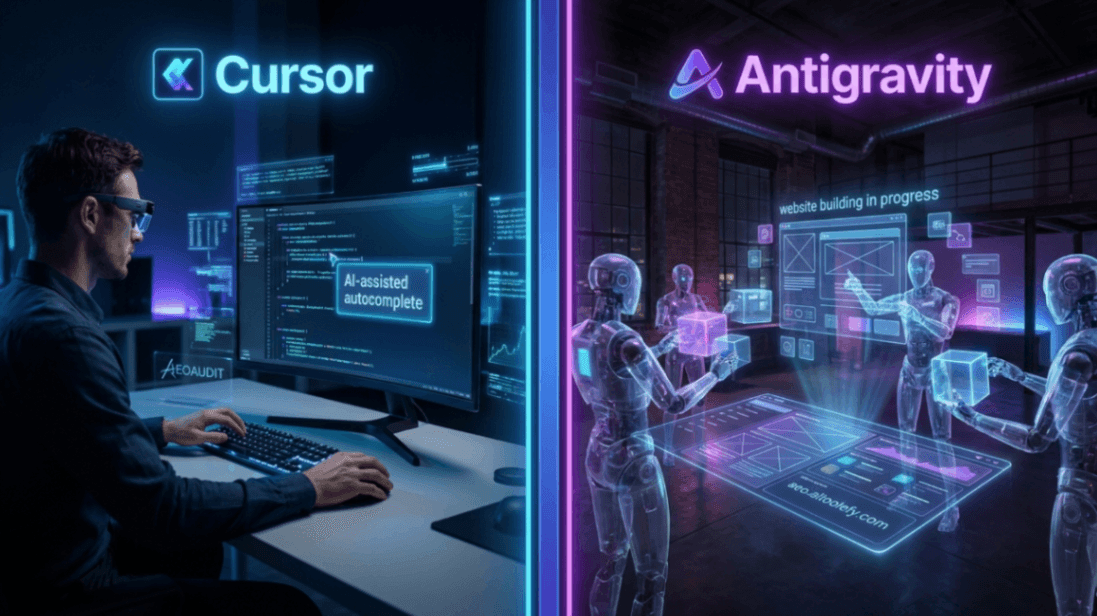
The landscape of software engineering has reached a violent inflection point, rapidly transitioning from static syntactic assistance to dynamic, autonomous code generation and orchestration. For decades, the evolution of developer productivity tools focused strictly on augmenting the speed at which a human operator could transcribe logic into an Integrated Development Environment (IDE).
The advent of foundational large language models (LLMs) initially adhered to this paradigm, introducing advanced, context-aware autocomplete agents operating within traditional code editors. However, the market has now rapidly bifurcated into two distinct and competing philosophical approaches to software creation: the AI-first editor (meticulously optimized for extreme developer velocity) and the agent-first command center (engineered for the autonomous delegation and orchestration of complex tasks).
The two apex platforms representing this fundamental divergence in mid-2026 are Cursor and Google Antigravity 2.0. This comprehensive analysis evaluates both platforms across their underlying architectural paradigms, technical execution capabilities, enterprise readiness, security postures, developer experience, and their long-term implications for the software engineering lifecycle.
Architectural Philosophies and Core Mental Models
Understanding the profound distinction between Cursor and Google Antigravity requires examining the underlying cognitive frameworks and mental models each platform demands from its users. The divergence extends far beyond competing feature sets; it is a fundamental reimagining of how a human interacts with an application's architecture.
Cursor: The AI-First Editor and The Augmentation Paradigm
Cursor operates on the principle of seamless augmentation. Its architecture adopts the universally familiar VS Code environment and layers profound, context-aware artificial intelligence across every interactive surface. The core mental model remains unchanged from traditional software development: the human engineer is the active driver, architecting systems, manipulating files, and writing code, while the AI acts as a vastly superior pair-programmer.
Cursor's primary objective is the total elimination of friction between human thought and digital implementation. It achieves this objective through hyper-aggressive, context-aware inline completions, a conversational coding agent capable of executing complex cross-file edits, and a deep, repository-wide semantic understanding of the codebase. The design philosophy inherently asserts that code elegance, tight architectural control, and the "craft" of software engineering still belong to the human operator.
Google Antigravity 2.0: The Agent-First Command Center
Google Antigravity 2.0 completely dismantles the traditional IDE-centric workflow. With the launch of version 2.0 at Google I/O 2026, Google fundamentally altered the platform's architecture, transforming it from a standard IDE extension into a standalone desktop operating layer exclusively for AI agents.
Antigravity operates on the principle of automation, orchestration, and delegation. Instead of the developer actively coding, they assume the role of a technical product manager. The central interaction surface is a "Manager Surface" utilized to spawn, orchestrate, and observe multiple autonomous agents working asynchronously. The developer reviews the artifacts left behind by the agents, redirects errant logic, and verifies the final output, intervening only when the agent deviates from the desired architectural path.
| Architectural Dimension | Cursor | Google Antigravity 2.0 |
|---|---|---|
| Core Operational Paradigm | AI-First Code Editor (Augmentation) | Agent-First Command Center (Delegation) |
| Primary Interaction Model | Inline autocomplete, integrated chat | Standalone manager surface, asynchronous tasking |
| Required Developer Role | Active coder, typist, and system architect | Supervisor, orchestrator, and artifact reviewer |
| Workspace Integration | Single unified VS Code fork | Decoupled suite: GUI app, distinct IDE, CLI, and SDK |
| Model Architecture | "Auto mode" multi-model routing (user-selected) | Gemini 3.5 Pro/Flash prioritization |
| Target Outcome | Extreme coding velocity, strict craft preservation | End-to-end task automation, massive rapid prototyping |
The Google Antigravity Ecosystem: A Structural Breakdown
To facilitate its radical vision of autonomous software engineering, Google expanded Antigravity from a single tool into a comprehensive suite of interlocking products, effectively fracturing the traditional monolithic development environment.
The Antigravity Command Center and Core Engine
The flagship application is the standalone Antigravity desktop hub. Operating completely independently of any IDE, it serves as the mission control where developers define agent personas, set global execution rules, and monitor parallel workflows. Under the hood, the Antigravity agent harness provisions a Linux sandbox for every API call, utilizing a context compaction mechanism that triggers at approximately 135,000 tokens to support incredibly long-running sessions.
The Antigravity CLI and Advanced Prompting Workflows
For engineers who operate exclusively within terminal environments, the Antigravity CLI brings reasoning, execution, and orchestration capabilities directly into remote SSH sessions. For developers actively utilizing platforms like Google AI Pro, the standard workflow often involves designing and requesting highly tailored prompts for models like Claude and Antigravity to execute specialized technical tasks—from complex database migrations to precise frontend refactoring. Because the CLI and the GUI share the same underlying state, a developer can execute complex prompted commands in a remote SSH terminal and subsequently export that session directly into the Antigravity 2.0 GUI to continue working visually.
The Artifact Verification System: Engineering Autonomous Trust
Delegating complex tasks to an autonomous agent introduces a massive vulnerability: the rapid erosion of trust. Antigravity 2.0 attempts to solve this through a rigid "Artifact" system, forcing agents to produce tangible deliverables at every sequential stage.
- Task Lists: The agent generates a highly structured strategic roadmap before executing code, allowing early human intervention.
- Implementation Plans: Granular technical specifications detailing precise file and library modifications.
- Headless Browser Screenshots: The agent can seamlessly spawn a headless local browser, interact directly with the compiled application, and capture layout verification screenshots.
- Mermaid Diagrams: Visual mapping of tight coupling or layering violations, allowing human supervisors to spot systemic flaws.
- Walkthroughs: A plain-language summary of completed work and manual testing instructions.
This artifact-first approach enables the highly sophisticated "test-and-tea" workflow, where an agent loops through massive integration suites autonomously while the human steps away.
Cursor: The Mastery of the Developer Experience
While Antigravity pioneers the autonomous orchestration model, Cursor utterly dominates the broader market by perfecting the synchronous developer experience. For the vast majority of working software engineers, full agentic delegation is a bridge too far. They require a tool that radically accelerates their existing workflow.
Repository-Wide Context Awareness
Cursor's primary competitive advantage is its flawless repository-wide context awareness. It natively indexes the entire codebase, allowing its conversational agent (Composer) to understand intricate, cascading relationships. Cursor features an intelligent "Auto mode" that dynamically routes queries to the optimal foundational model—whether OpenAI for Python backend logic or Anthropic's Claude for TypeScript component generation.
Frictionless Integration and the Context-Switching Tax
Cursor's strategic decision to build upon the open-source VS Code foundation is a masterclass in reducing adoption friction. A developer installs Cursor and is immediately productive within five minutes, utilizing the exact same hotkeys they have used for years.
By contrast, users extensively testing Antigravity note that the context-switching cost is severe. Forcing a developer to navigate constantly between the Antigravity Manager application to monitor prompts and a separate IDE window to verify the raw syntax imposes a massive, hidden cognitive tax.
Enterprise Readiness, Governance, and Security Posture
In the corporate environment, the choice of an AI development platform is dictated primarily by governance infrastructure, compliance certifications, and operational scalability.
Cursor's Enterprise Dominance
Cursor boasts adoption in a staggering 64% of Fortune 500 companies. It ships with product-specific SOC 2 Type II certification and offers granular governance infrastructure. Furthermore, Cursor addresses organizational knowledge scaling with its "Cosmos" feature, a centralized intelligence layer that coordinates AI agents across disparate repositories and teams, ensuring a shared organizational memory.
Antigravity's Transitional State and The Security Crisis
Google Antigravity's enterprise posture remains in a highly volatile state. The primary deterrent involves its fundamental security architecture. The ability to execute terminal commands autonomously introduces severe supply chain risks. Within 24 hours of launch, prominent security researcher Aaron Portnoy disclosed a critical zero-day vulnerability enabling persistent backdoor access. This lack of transparent audit trails and high-profile vulnerabilities render it a high-risk proposition for compliance-bound organizations.
The Hidden Layer: Documentation and Agentic Discoverability
There is a massive, unspoken implication for teams building APIs or SaaS products in the era of Cursor and Antigravity. These coding agents do not just read your local files; they actively browse the web to read external documentation. If your company's API documentation is heavily reliant on client-side JavaScript or lacks clean JSON-LD structuring, Antigravity's headless browser agents will fail to read it. Consequently, the AI will refuse to integrate your tool into the developer's codebase, opting for a competitor with machine-readable docs instead.
Ensuring your technical documentation is optimized for these LLM coding agents is a core pillar of Answer Engine Optimization (AEO). By utilizing an AEO and GEO audit platform like AeoAudit, technical writing teams can verify that their llms.txt files and markdown documentation are perfectly structured for autonomous parsing by Cursor and Antigravity agents, securing your tool's place in the modern tech stack.
Economics, Quotas, and Integration Workflows
Cursor operates on a highly predictable B2B SaaS pricing model ($20/month Pro subscription), providing independent developers and organizations with a flat operational cost.
Antigravity's quota systems, however, have been a source of controversy. While it offers a generous free tier, developers subscribing to the $20/month Google One AI Premium plan quickly discover that autonomous agents exhaust monthly token quotas almost instantly. To address this compute bottleneck, Google introduced the "Google AI Ultra" subscription at $100/month. This $1,200 annual cost places Antigravity squarely in the premium enterprise tier, shifting the economics of AI-assisted development.
Conclusion
The choice between Cursor and Google Antigravity 2.0 is a profound strategic decision regarding how a development team envisions the future of software creation.
Cursor is the definitive choice for the modern enterprise and the craft-focused engineer. With rigorous SOC 2 Type II compliance, robust organizational memory, and an unmatched, frictionless developer experience, it represents the absolute apex of the augmentation paradigm.
Google Antigravity 2.0 is a volatile, highly raw, and wildly ambitious glimpse into the agentic future. It intentionally sacrifices immediate software stability in pursuit of a workflow where software engineers manage autonomous systems. For the foreseeable future, the most effective organizations will adopt a bifurcated strategy: leveraging Antigravity as an experimental "idea factory" for rapid infrastructure scaffolding, while relying entirely on the stable, secure environment of Cursor to surgically construct and deploy mission-critical production systems.
Frequently Asked Questions (FAQ)
Can I use my own local LLM models with Cursor or Antigravity?
Cursor heavily relies on cloud-based foundational models (OpenAI, Anthropic) to maintain its repository-wide indexing speed, though API overrides are possible. Antigravity, specifically through tools like OpenCode, has actively courted the "vibe coding" community by allowing configuration with free local models (like OAMA), establishing workflows that run entirely on local hardware.
What is a "Vibe Coder"?
A "vibe coder" is an industry term popularized in the mid-2020s describing a developer who provides high-level intent, emotional direction, and broad architectural desires in natural language, while relying entirely on the AI (often tools like Antigravity) to handle granular syntax, boilerplates, and deployment pipelines.
Why did Google decouple Antigravity from a traditional IDE?
Google's thesis is that true autonomous agents require an OS-level workspace to coordinate specialized subagents, manage long-running background maintenance tasks, and execute multi-tool workflows entirely on their own, free from the constraints of a single text editor window.
How do I ensure Antigravity agents can read my company's API docs?
You must optimize your documentation for Generative Engine Optimization (GEO). Implement an llms.txt file, use strict Markdown tables, and ensure your documentation does not rely on JavaScript hydration. Running a technical compliance scan with AeoAudit will flag the exact elements preventing AI coding agents from reading your site.
Helping brands dominate the new era of AI Search and Generative Engine Optimization.
Audit your content for AI Search.
Apply the strategies from this article automatically. Discover exactly how AI overviews see your website.
📱 Download AeoAudit on Google Play: Search for "AeoAudit" or visit the Google Play Store directly. Perfect for SEO professionals and website owners on the go.