
How Multimodal AI Models Read and Rank Product Images Directly
Traditional image SEO (like basic alt text) is obsolete. Discover how multimodal AI models like GPT-4o and Gemini natively process pixels, context, and visual sentiment to rank ecommerce products in 2026.
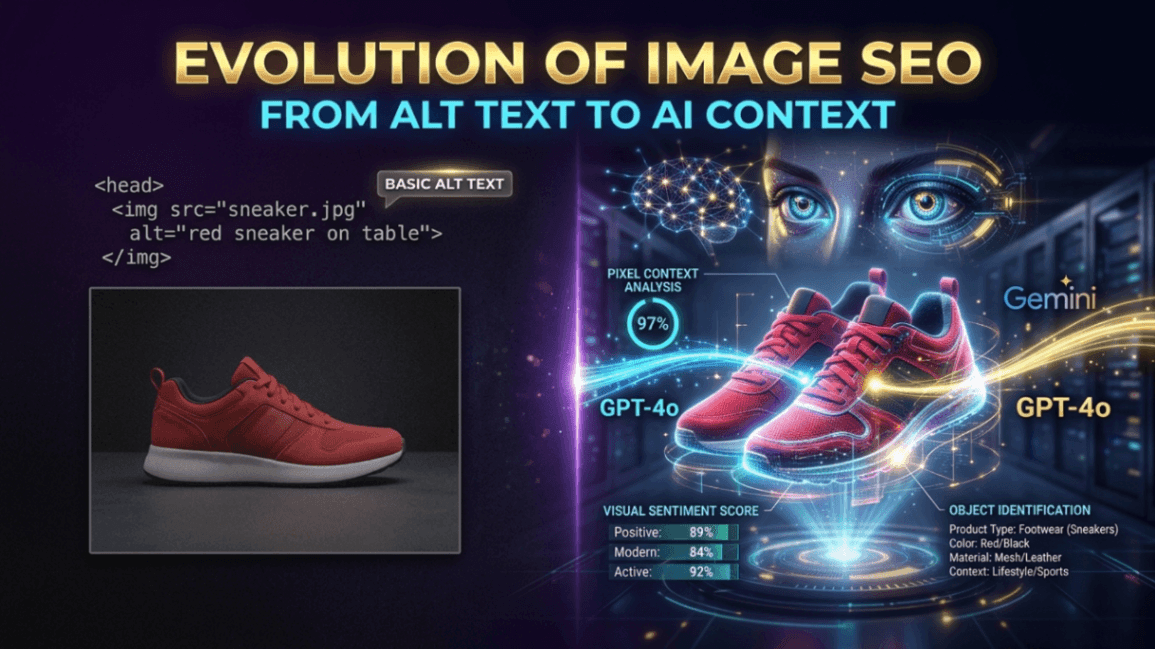
For years, search engine optimization relied on a glaring blind spot: search engines were fundamentally blind. They couldn't actually see your product images. They relied entirely on human-provided text—specifically the file name and the alt text—to guess what an image contained.
If you named a picture of a coffee mug red-sneakers.jpg and gave it the alt text "Best red sneakers," traditional search engines would happily index it as a shoe.
In 2026, that trick will get your entire domain penalized by Answer Engines. Welcome to the era of Multimodal AI Search.
Models like GPT-4o, Gemini Pro, and Claude 3.5 do not just "read" the text surrounding your image; they natively process the image itself. They analyze the pixels, interpret the lighting, gauge the sentiment, and cross-reference the visual data with your text. If your digital assets are not structured for multimodal AI systems, your brand is effectively invisible in visual search.
How Multimodal AI "Sees" Your Products
To optimize for visual search, you must first understand how a multimodal model processes an image. It does not look at a picture the way a human does. It translates the image into math.
1. From Pixels to Vector Embeddings
When an AI crawler lands on your product image, it passes the visual data through a neural network, converting the image into a high-dimensional mathematical coordinate called a vector embedding. Simultaneously, it converts your text description into a vector embedding in the exact same mathematical space.
If the math of the image (a red sneaker) does not closely align with the math of your text (a description of a blue boot), the AI flags the page as contradictory, low-quality, or hallucinated, and removes it from its recommendation engine.
2. The Concept of "Grounding"
Multimodal AI evaluates the trustworthiness of an image through a concept called Grounding. An image is considered "grounded" when the visual data perfectly corroborates the text on the page.
If your e-commerce page claims a jacket is "waterproof and heavily insulated for extreme snow," the AI will analyze the image texture. If the image shows a thin, glossy windbreaker, the AI will distrust the text. Visuals are now fact-checking mechanisms for your copywriting.
3. Visual Sentiment Analysis
This is the most cutting-edge development in 2026. AI doesn't just categorize objects; it categorizes vibes. If a user prompts ChatGPT with, "Find me a minimalist, earthy, and calming ceramic vase," the AI analyzes the lighting, background, and color palette of your product photography to determine if it fits the "calming" and "earthy" sentiment.
How to Optimize for Multimodal Visual Search
Slapping a keyword in your alt text is no longer optimization. Here is the 2026 playbook for Multimodal GEO (Generative Engine Optimization).
1. Write Semantic, Contextual Alt Text
Stop keyword stuffing. You must anchor the image in its specific context. AI models use alt text to bridge the gap between their visual processing and human intent.
- Old SEO Alt Text:
"Bar chart SaaS revenue growth software" - Multimodal Alt Text:
"A blue and grey bar chart demonstrating a 25% year-over-year Q4 revenue growth for enterprise SaaS platforms."
2. Maintain "Entity Consistency" Across Modalities
AI models look for "Entity Co-occurrence." If you are selling a high-end espresso machine, the visual setting matters. If the product is photographed on a messy desk instead of a clean, marble kitchen counter, the AI may categorize the entity as "office equipment" rather than "luxury kitchenware." Ensure your backgrounds reinforce the product's intended entity category.
3. Implement Explicit ImageObject Schema (JSON-LD)
You cannot rely on visual processing alone. You must provide a structured data map. Ensure every high-value image on your site is wrapped in ImageObject schema. This must explicitly list the contentUrl, creator, caption, and how it relates to the primary Product schema.
The Shift: Traditional Image SEO vs. Multimodal GEO
| Optimization Element | Traditional Image SEO (2020) | Multimodal Image GEO (2026) |
|---|---|---|
| Primary Goal | Rank in Google Images via keywords | Be synthesized in AI chat recommendations |
| File Naming | Keyword stuffed (e.g., best-shoes.jpg) | Descriptive and entity-aligned |
| Alt Text | Used as a hidden keyword container | Semantic descriptions that provide context |
| Image Content | Irrelevant; search engines couldn't see it | Analyzed for texture, sentiment, and grounding |
| Structure | Basic HTML <img> tags |
Deep JSON-LD ImageObject connected to entities |
How to Audit Your Multimodal Readiness
Because humans cannot see vector embeddings, you cannot manually check if an AI model is interpreting your images correctly. A page might look beautiful to you, but an AI bot might be discarding it due to conflicting contextual signals or broken structured data.
This is where specialized tools are required. By running your pages through an AEO and GEO audit, you can simulate how a multimodal AI views your digital assets. AeoAudit checks the semantic alignment between your text and images, verifies your ImageObject schema, and highlights where your visual data is failing to ground your textual claims.
Frequently Asked Questions (FAQ)
Can AI models read text inside my images?
Yes, perfectly. Modern multimodal models have flawless Optical Character Recognition (OCR). If you have an infographic or a chart, the AI will read the text inside the image. However, it is still best practice to summarize that text in the surrounding HTML so the model can cross-reference it for accuracy.
Do image file sizes still matter for AI?
Absolutely. While AI is smarter, crawler bandwidth is still expensive. If your image is 5MB and takes 4 seconds to load, AI bots (like ClaudeBot or GPTBot) will frequently abandon the crawl before the image renders, meaning your visual data is never processed. Always compress to WebP or AVIF formats.
Does multimodal search apply to B2B companies?
Yes. In B2B, visual search is heavily reliant on diagrams, workflow charts, and architecture maps. If a user asks an AI, "Explain how microservices work," the AI is highly likely to retrieve and display a well-labeled, structured diagram from a B2B blog rather than just a wall of text.
Helping brands dominate the new era of AI Search and Generative Engine Optimization.
Audit your content for AI Search.
Apply the strategies from this article automatically. Discover exactly how AI overviews see your website.
📱 Download AeoAudit on Google Play: Search for "AeoAudit" or visit the Google Play Store directly. Perfect for SEO professionals and website owners on the go.