
Why AI Search Traffic Converts 42% Better Than Traditional E-commerce SEO
In Q1 2026, AI-referred traffic surged by 393% and converted at a 42% higher rate than standard Google search. Discover why the AI-assisted shopping funnel is destroying the traditional e-commerce playbook.
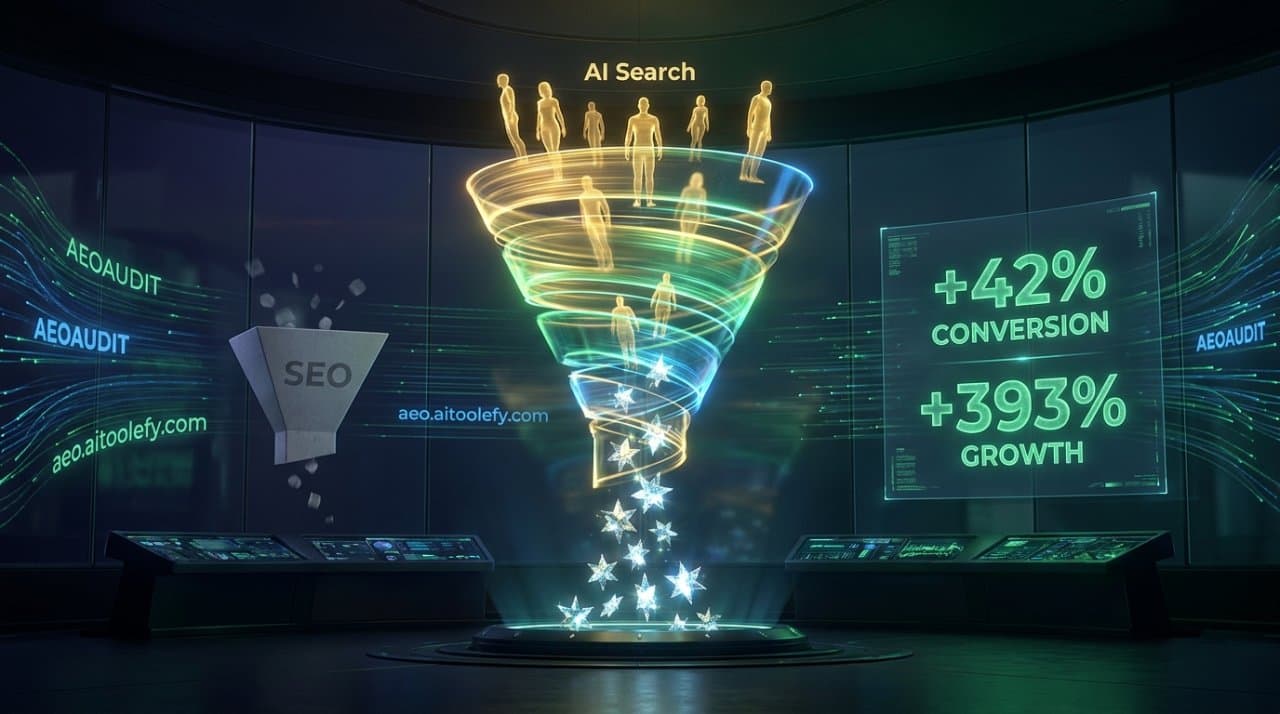
If you run an e-commerce brand or manage growth for a digital retailer, you have likely noticed a severe, structural shift in your analytics dashboard over the last six months. Traditional organic search traffic is plateauing, or in some sectors, actively declining. But underneath that top-line metric lies a far more important trend.
In the first quarter of 2026, AI-referred traffic to U.S. retail sites surged by a staggering 393% year-over-year. However, the most impressive metric is not the sheer volume of this new traffic; it is the quality of the buyer it brings.
Recent market data shows that AI referrals are currently converting at a 42% higher rate than traditional organic traffic sources.
Why is a link generated by ChatGPT, Perplexity, or Claude driving so much more revenue than a standard Google search click? It is not a fluke, and it is not a temporary trend. It comes down to a fundamental architectural shift in how the digital shopping journey works. Here is why the AI buyer converts so heavily, and exactly what your brand must do to capture them.
The End of the "Endless Aisle" and Decision Fatigue
To understand the conversion power of Answer Engine Optimization (AEO), we must first analyze why the traditional e-commerce funnel is leaking.
For decades, digital retail relied exclusively on a "search-and-click" model. A shopper types a broad keyword into Google (e.g., "best laptop backpacks"). They are met with ten blue links, a carousel of paid ads, and several affiliate listicles. The shopper opens dozens of tabs, hunts for technical specifications buried in marketing copy, reads subjective reviews, and manually attempts to compare dimensions and prices across different domains.
While this model successfully gave consumers the "endless aisle," it also created massive, paralyzing decision fatigue. In the traditional SEO era, shoppers came to your storefront to research and discover at the exact same time. As a retailer, you had to capture their attention, guide them through the grueling research phase, and persuade them to buy—all while they were highly likely to abandon their cart out of sheer exhaustion or bounce to a competitor to verify a price.
The Era of the Digital Sales Associate
AI shopping agents operate entirely differently, utilizing a "query-and-synthesize" model.
Instead of forcing the user to hunt for disparate details across the web, the AI agent acts as a top-tier, hyper-competent digital sales associate. When a user asks an AI assistant to find "the best waterproof hiking boots under $150, available in a men's size 11, with a flexible return policy," the AI does the heavy lifting instantly.
It autonomously queries multiple brand catalogs, evaluates technical specifications, compares real-time prices, and strictly validates logistical details like shipping times and return policies before ever presenting the options to the user. The AI strips away the noise and delivers a highly curated, mathematically verified shortlist.
Why the AI Buyer Converts 42% Higher
The core reason AI traffic converts at such an unprecedented rate is that the research phase has been entirely decoupled from the storefront visit.
1. Complete Pre-Qualification
By the time an AI-assisted shopper actually clicks through a citation link to land on your website, they have already been fully informed by the AI. All of their personal constraints—budget, size, specific feature requirements, and shipping timelines—have already been validated by the machine. They are no longer window-shopping; they are executing a purchase mandate.
2. The Transfer of Trust
When a human reads a brand's product page, they are inherently skeptical. They know they are reading marketing copy designed to sell. However, when an objective, third-party Large Language Model (LLM) evaluates thousands of data points and objectively concludes that your product is the single best fit for the user's highly specific prompt, a massive psychological "Trust Transfer" occurs. The user trusts the AI's synthesis, and that trust immediately extends to your product.
3. Zero-Friction Intent
Because the AI has eliminated the decision fatigue of the "endless aisle," the user arrives at your domain with extreme high-intent. The AI has effectively handled the messy top-and-middle of the sales funnel for you, leaving your storefront to handle only the final conversion.
Visualizing the Funnel Compression
| Funnel Stage | Traditional SEO Buyer Journey | AI-Assisted Buyer Journey |
|---|---|---|
| 1. Discovery | Searches broad keyword, clicks top 5 links. | Enters highly specific, multi-constraint prompt into LLM. |
| 2. Research | Happens ON your website (high bounce risk). | Happens INSIDE the AI chat (AI reads your backend data). |
| 3. Comparison | User opens competitor tabs to compare specs. | AI mathematically compares specs in milliseconds. |
| 4. Storefront Visit | User arrives confused, evaluating options. | User arrives pre-qualified, ready to checkout. |
| 5. Conversion Rate | Average (2% - 3%) | Surging (+42% Baseline) |
What Retailers Must Do to Capture the AI Buyer
This massive shift in conversion dynamics means that the "front door" of your business has moved. If your strategy still relies solely on traditional, keyword-stuffed SEO to capture human eyes on a Google SERP, you are bleeding out the highest-converting traffic on the internet.
AI agents do not care about persuasive copywriting, aesthetic UI layouts, or promotional pop-up banners. They parse raw data. To ensure your products are the ones selected and recommended by these autonomous agents, you must transition your infrastructure toward Generative Engine Optimization (GEO) and Large Language Model Optimization (LLMO).
1. Deploy Advanced JSON-LD Semantic Schema
Basic product schema is no longer sufficient. To survive the AI filter, you must implement deep, exhaustive JSON-LD. If a user asks the AI for a product that "ships within 3 days," and your site lacks the ShippingDeliveryTime schema, the AI will ignore you. You must programmatically expose MerchantReturnPolicy, exact stock availability, and deterministic pricing.
2. Transition to Machine-Readable Formatting
AI models extract factual data significantly faster and more reliably from HTML or Markdown tables than from dense paragraphs of prose. If you have technical specifications (dimensions, materials, weight, compatibility), move them out of your marketing paragraphs and into strict, clean tables. High "Information Density" is the key to securing an AI citation.
3. Server-Side Rendering is Mandatory
Many lightweight AI bots (like those powering Perplexity or ChatGPT plugins) do not wait for heavy client-side JavaScript to execute. If your pricing or availability only loads after a JS script fires, the bot will read a blank HTML skeleton and assume the product is out of stock. You must serve fully populated, server-side rendered (SSR) pages to non-human user agents.
The AeoAudit Mandate: Measuring the Invisible Funnel
The hardest part of this transition is that traditional analytics platforms are failing marketers. A massive portion of AI-referred traffic strips referral headers, meaning it shows up in Google Analytics as "Direct" traffic (often referred to as Dark Social). Furthermore, Google Search Console will not tell you if you are losing Share of Model (SoM) inside ChatGPT or Claude.
You cannot capture 42% higher conversion rates if you are invisible to the machines sourcing the traffic. This is why utilizing a dedicated diagnostic platform like AeoAudit is mandatory for serious e-commerce brands in 2026.
By running a comprehensive AEO and GEO audit, you can simulate how autonomous shopping agents parse your product catalog. AeoAudit identifies exactly where your JSON-LD schema is failing, flags JavaScript rendering bottlenecks that block AI crawlers, and measures your brand's citation frequency across the top Answer Engines. If you want to put your products in front of the most highly motivated, pre-qualified buyers on the web, you must ensure the machines can read your data perfectly.
Frequently Asked Questions (FAQ)
Why is my Google Analytics showing a drop in traffic, but revenue is stable?
This is the classic hallmark of the AEO shift. You are losing low-quality, top-of-funnel "research" traffic because users are getting their answers directly from AI Overviews or ChatGPT. However, because AI referrals convert at a much higher rate, your bottom-of-the-funnel, highly qualified traffic is making up for the raw volume loss, stabilizing your revenue.
How do I know if my website is optimized for AI Shopping Agents?
Standard SEO audit tools (like Ahrefs or Screaming Frog) check for human-centric ranking signals. To check for AI readiness, you need a specialized tool that evaluates Information Density and schema logic. Running your domain through an AEO and GEO audit is the only way to accurately simulate an LLM's RAG (Retrieval-Augmented Generation) ingestion process.
Should I delete my persuasive copywriting to make room for data tables?
No. Human buyers still need to be persuaded once they land on your site. The goal of Generative Engine Optimization is to serve both audiences. Keep your beautiful, emotional copywriting for the human eye, but ensure the exact same technical facts are heavily structured in the backend JSON-LD schema and in a clean "Fast Facts" table for the AI crawler.
What is the difference between LLMO and GEO?
LLMO (Large Language Model Optimization) is the macro strategy of associating your brand entity with specific topics within the AI's broad training data (often via digital PR and offsite consensus). GEO (Generative Engine Optimization) is the technical, tactical process of formatting your specific on-page content (using tables, markdown, and precise schema) so the AI can easily extract your data during a real-time retrieval query.
Helping brands dominate the new era of AI Search and Generative Engine Optimization.
Audit your content for AI Search.
Apply the strategies from this article automatically. Discover exactly how AI overviews see your website.
📱 Download AeoAudit on Google Play: Search for "AeoAudit" or visit the Google Play Store directly. Perfect for SEO professionals and website owners on the go.