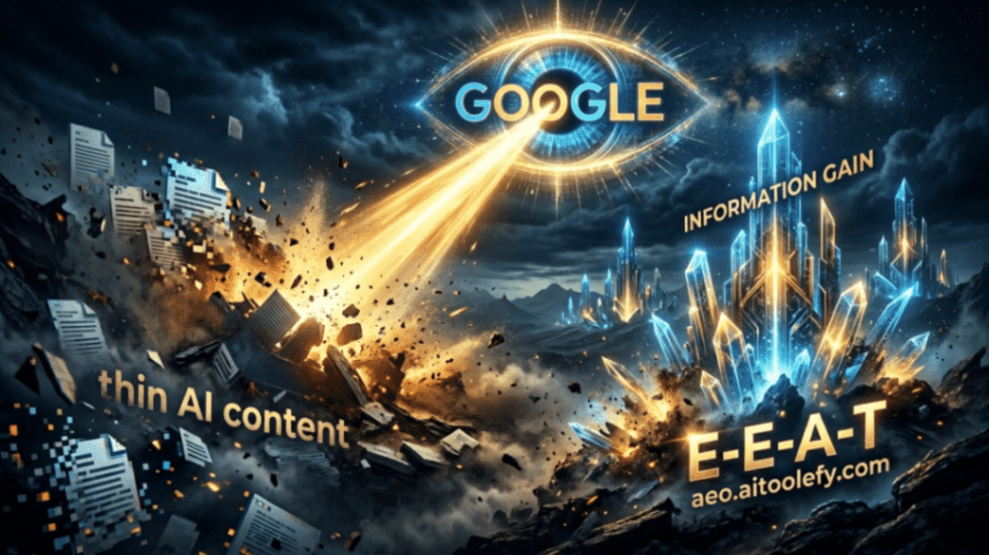
On June 2, 2026, Google officially completed the rollout of its most destructive core update of the year. When the dust settled after the 12-day volatility period, the SEO community was left staring at a bloodbath for a very specific type of website: those relying on scaled, low-effort AI content.
Early data indicates that an unprecedented 80% of top-10 search results experienced significant position shifts. The biggest losers? Programmatic SEO sites and affiliate blogs that used LLMs to churn out thousands of "Ultimate Guides" by merely summarizing existing web pages.
Google didn't just tweak the algorithm; they fundamentally shifted the scoring mechanism from Information Retrieval to Information Gain. If you are still using AI to write content for AI, your traffic is officially on borrowed time.
The Death of the "Aggregated Summary"
For the last two years, marketers have abused AI to scale content production. The playbook was simple: scrape the top 5 ranking articles for a keyword, ask an LLM to rewrite and combine them, and publish it as a "comprehensive" new piece.
The June 2026 Core Update killed this playbook. Google's systems can now easily detect when an article contains zero net-new value compared to the existing index. If your article is just a synthesized regurgitation of what is already ranking, the algorithm will aggressively suppress it.
The New Standard: Information Gain
To survive in the back half of 2026, your content must possess Information Gain. This metric measures the amount of new information a user receives from your page that they haven't seen on any of the previously clicked pages in the SERP.
How do you achieve high Information Gain?
- Proprietary Data: Publish statistics, poll results, or internal company data that does not exist anywhere else on the internet.
- Original Research & Case Studies: Document your own "in-the-trenches" experiments. (e.g., "We tested 500 prompts and found this result.")
- Contrarian Expertise: Don't just agree with the consensus. Offer a highly specialized, expert opinion that challenges the status quo.
- Human Quotes: Interview Subject Matter Experts (SMEs) and embed their direct quotes. LLMs cannot hallucinate genuine human interviews.
Welcome to E-E-A-T 2.0: The Holistic Brand Entity
E-E-A-T (Experience, Expertise, Authoritativeness, and Trustworthiness) is not new, but the June 2026 update changed how Google applies it. Previously, Google looked for E-E-A-T signals on an individual page level (like an author bio). Now, they are evaluating your entire brand as a holistic entity.
If you publish a brilliant, expert-level article about cybersecurity, but the rest of your domain is filled with thin, auto-generated affiliate content about "best gaming laptops," Google will penalize the good article because the overall entity trust score of the domain is compromised.
What You Must Do Next
If your organic traffic vanished between May 21 and June 2, 2026, do not try to fix it by tweaking meta tags or disavowing links. You have a structural content problem.
- Audit for Thin AI Content: Identify every page on your site that was generated via AI without a human adding proprietary insights. De-index or completely rewrite them.
- Build Your Knowledge Graph: Clearly define who your authors are, link out to their active social profiles, and ensure your business's "Entity Home" (your About page) is structured perfectly.
- Shift Focus to AEO: As traditional SERPs become more volatile, you must ensure your brand is cited by Answer Engines like ChatGPT, Perplexity, and Claude.
Because Google is actively penalizing generic content, securing visibility inside AI chat interfaces is more critical than ever. However, tracking this manually is impossible. You need a dedicated AEO and GEO audit to measure your Share of Model.
By using AeoAudit, you can scan your domain to identify exactly where your semantic depth is lacking, ensure your entity data is machine-readable, and prove that your brand has the Information Gain required to survive the June 2026 fallout.