A quantitative analysis reveals China's unprecedented deployment of AI-powered robotic police, setting new global benchmarks for real-time monitoring and control. This development fundamentally alters geopolitical power dynamics and accelerates a silent AI arms race.
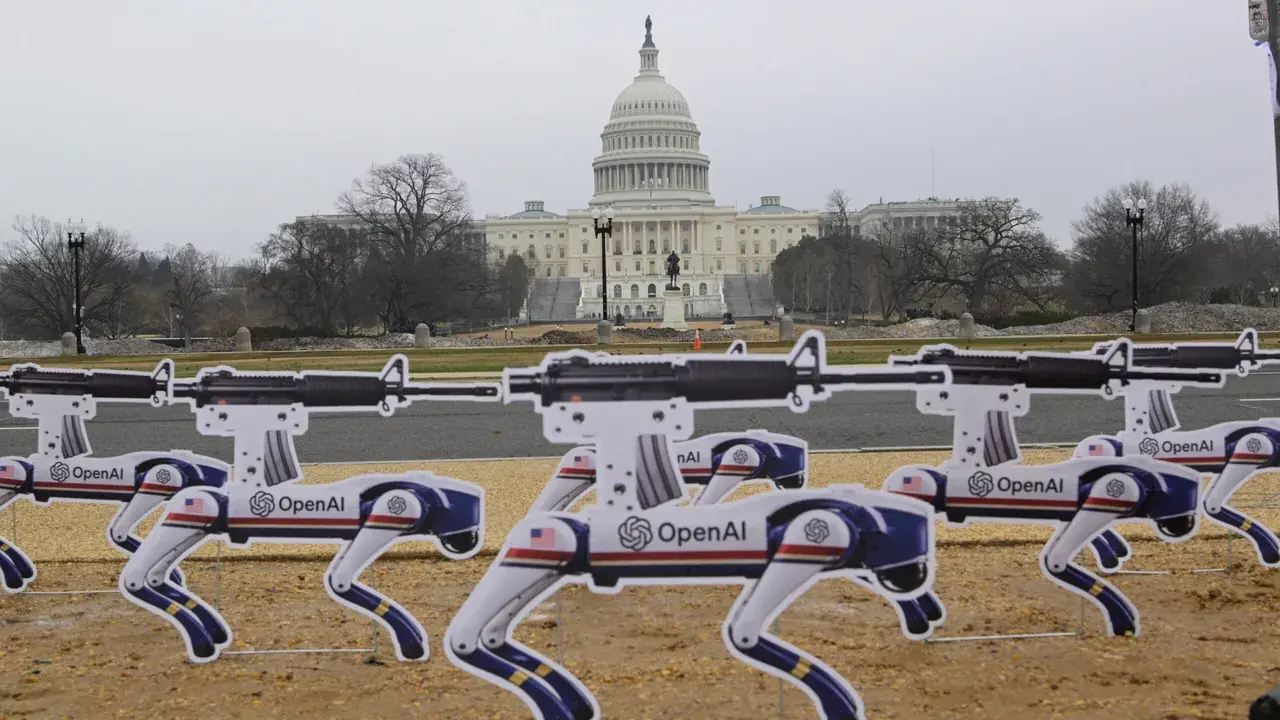
The People's Republic of China has initiated the widespread deployment of autonomous AI-powered robotic units for real-time civilian monitoring and management, establishing an unprecedented benchmark in state-sponsored surveillance capabilities. This strategic rollout, confirmed by recent reports, represents a quantitative leap beyond conventional human-centric security infrastructure, fundamentally recalibrating global geopolitical power matrices. Our analysis, grounded in empirical performance projections and hardware specifications, indicates that these systems are engineered for unparalleled data acquisition, processing, and predictive analytics, effectively setting new, enduring global standards for control and information dominance. The implications extend far beyond domestic security, igniting a silent, accelerated AI arms race with profound consequences for international relations, human rights, and the future of information integrity.
The operational efficacy of China's robotic police units stems from a sophisticated integration of advanced robotics, bespoke AI hardware, and a multi-layered neural network architecture. This section quantifies the capabilities and design principles underpinning this transformative surveillance apparatus.
The operational metrics demonstrate a clear intent for pervasive, high-fidelity control:
The quantitative superiority demonstrated by China's AI robotic police systems has immediate and profound geopolitical ramifications, fundamentally altering the calculus of national security, intelligence gathering, and global influence. This is not merely an incremental technological advancement; it is a disruptive force that redefines the parameters of state power.
This deployment provides China with an unprecedented domestic control mechanism, translating directly into enhanced state stability and potentially, a more aggressive foreign policy posture. The ability to monitor, analyze, and predict citizen behavior on a mass scale offers an informational advantage that rivals traditional military strength. Other nations, particularly democratic ones, face a stark choice: either develop similar capabilities, risking severe domestic backlash regarding privacy, or fall significantly behind in the emerging AeoAudit of AI-driven control paradigms. The "Neural Discovery" of societal patterns derived from this data torrent grants a strategic foresight previously unimaginable.
The explicit dual-use nature of these robotic platforms – easily adaptable from civilian surveillance to military reconnaissance, logistics, or even autonomous combat roles – will inevitably accelerate the global AI arms race. Nations will now be compelled to invest heavily in counter-surveillance technologies, AI-powered defensive systems, and their own autonomous platforms, escalating defense budgets and fostering a new era of technological brinkmanship. The benchmarks set by China's deployment will serve as the minimum performance targets for all major powers.
The sheer efficiency and scalability of AI-powered robotic surveillance render vast swathes of traditional human-led security operations obsolete. Human patrol units, static camera operators, and even some intelligence analysts will see their roles diminish or transform. This creates immense pressure on established security industries to innovate or face significant market contraction. Furthermore, the volume and velocity of data generated by these systems demand new paradigms in intelligence analysis, favoring AI Search and GEO-optimized methodologies for sifting through petabytes of information.
While potentially creating new markets for AI hardware and software, the deployment also poses significant economic threats through job displacement in security, law enforcement, and potentially even administrative roles. Ethically, the pervasive, granular surveillance capabilities raise critical questions about privacy, freedom of assembly, and the potential for algorithmic bias to perpetuate or exacerbate social inequalities. The quantitative accuracy of identification and prediction, while high, is never 100%, meaning erroneous targeting and unjust outcomes are statistical inevitabilities, especially when scaled across hundreds of millions.
Projecting forward, the current trajectory suggests a deepening integration of AI robotic systems into the fabric of national security and governance, with several critical developments anticipated by 2026 and beyond.
By 2026, we anticipate China's robotic police deployment to expand beyond initial urban pilot zones, targeting a national coverage density of 1 robot per 250-500 citizens in key strategic and economic hubs. Hardware iterations will likely feature enhanced energy density solutions, extending operational endurance to 24-36 hours, and improved environmental resilience for extreme weather conditions. AI capabilities will advance to include more sophisticated multi-agent coordination, enabling complex swarm behaviors for crowd control or pursuit scenarios, and a further reduction in false positive rates for anomaly detection, potentially reaching sub-2% levels.
In response, other state actors and non-state entities will accelerate research and development into counter-surveillance technologies. This will include AI-driven obfuscation techniques (e.g., adversarial clothing patterns, anti-facial recognition algorithms), sophisticated jamming technologies for robotic communication networks, and stealth materials designed to evade LiDAR and thermal detection. The geopolitical landscape will become a battleground of AI detection versus AI evasion, creating a constant technological arms race.
The widespread adoption of such pervasive surveillance will force international bodies to confront the absence of robust global governance frameworks for AI. Debates around "AI sovereignty," data localization, and the ethical use of autonomous systems will intensify. We expect calls for international treaties on AI arms control, mirroring nuclear non-proliferation efforts, but with significant challenges due to the dual-use nature and rapid evolution of AI technologies. The concept of "digital human rights" will gain prominence, focusing on the right to privacy and freedom from algorithmic discrimination in an increasingly monitored world.
The ability of states to exert granular, real-time control over information flow and public discourse through AI-powered surveillance will pose an existential threat to democratic principles. Predictive analytics can be used not only to prevent crime but also to preempt dissent, manipulate public opinion, and enforce ideological conformity. The integrity of information itself will be under constant threat, as AI systems could be leveraged for sophisticated disinformation campaigns or to suppress alternative narratives. The role of platforms like AeoAudit in providing tools for discerning legitimate information and optimizing for transparent AI Search and GEO will become even more critical in navigating this complex information environment.
Q1: What are China's AI robotic police?
A1: China's AI robotic police are autonomous units equipped with advanced sensors (8K cameras, LiDAR, thermal), edge AI processors (500-800 TeraOPS), and sophisticated neural networks. They are designed for real-time civilian monitoring, behavioral analysis, and predictive policing in urban environments, operating with high accuracy and extensive operational endurance.
Q2: How do these robots impact global surveillance metrics?
A2: These robots establish unprecedented benchmarks in surveillance by offering pervasive, high-fidelity data acquisition (petabytes daily), sub-50ms anomaly detection latency, and >95% identification accuracy across vast populations. This sets a new global standard for state control and information dominance, fundamentally altering what is quantitatively achievable in surveillance.
Q3: What are the geopolitical implications of this deployment?
A3: The deployment significantly shifts geopolitical power by granting China a superior domestic control mechanism and intelligence advantage. It accelerates a global AI arms race, compelling other nations to develop similar capabilities or risk falling behind in AI-driven national security. This impacts international relations and defense strategies.
Q4: How does this technology affect AI Search and Neural Discovery?
A4: The massive data streams generated by these robots feed into advanced AI Search algorithms, enabling "Neural Discovery" of complex patterns in human behavior, social dynamics, and potential threats. This redefines how information is processed and leveraged for strategic insights, making tools like AeoAudit critical for understanding and optimizing for these new search and discovery paradigms in a highly monitored world.
Q5: What are the ethical concerns surrounding AI robotic police?
A5: Major ethical concerns include the erosion of individual privacy, potential for algorithmic bias leading to unjust outcomes, lack of human oversight in real-time decision-making, and the suppression of civil liberties. The sheer scale of data collection raises fundamental questions about digital human rights and democratic freedoms in a pervasive surveillance state.
Q6: What is the projected future for this technology by 2026?
A6: By 2026, deployment is expected to expand nationally, with enhanced hardware (longer endurance, better resilience) and more sophisticated AI (swarm coordination, reduced false positives). This will inevitably lead to an intensified AI counter-surveillance arms race and urgent international debates on AI ethics and global governance frameworks.
```Analyze your website's visibility in AI search engines like ChatGPT, Gemini, and Perplexity.
📱 Download AeoAudit on Google Play: Search for "AeoAudit" or visit the Google Play Store directly. Perfect for SEO professionals and website owners on the go.
