Empirical data from the newly released 2026 Wilbur Labs Startup Failure Report reveals a brutal market correction, with 50% of founders identifying AI disruption as their terminal risk and over $15 billion in venture capital already vaporized.
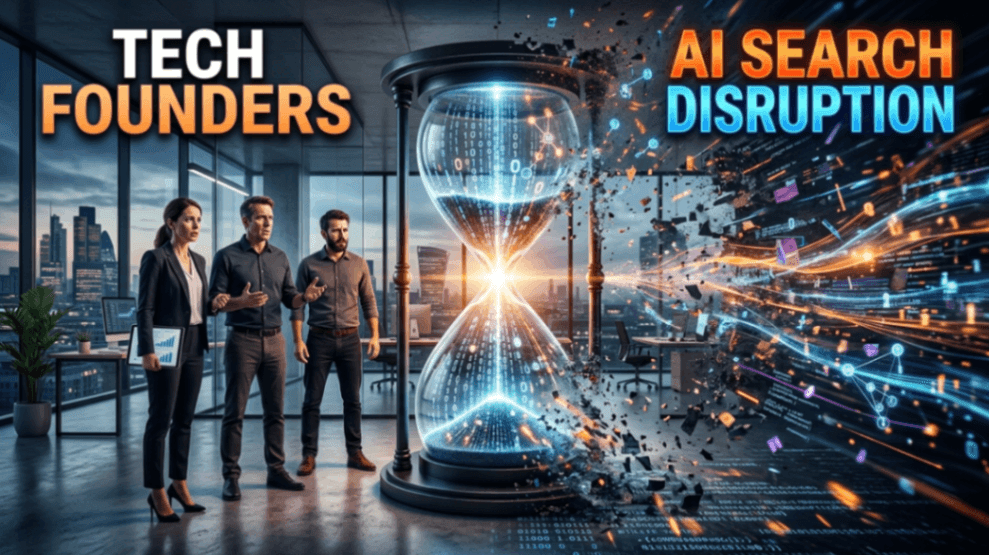
Empirical data gathered in the first half of 2026 indicates a structural realignment in the tech startup ecosystem. According to the 2026 Report on Startup Failure released by Wilbur Labs, exactly 50% of technology founders now identify rapid technological disruption—specifically the proliferation of generative artificial intelligence—as the single greatest existential threat to their businesses. Furthermore, 59% of active founders state they are highly concerned about their company’s financial solvency over the next 12 months.
This quantitative anxiety is not unfounded. Data compiled by industry trackers reveals that Q1 2026 has already witnessed the collapse of over 20 notable AI-native startups, translating to more than $15 billion in lost venture capital funding. The primary driver of these terminal failures is not a lack of capital or ambition, but a fundamental mismatch in product-market fit (cited by 54% of failed founders) and severe technological obsolescence (cited by 44%). As large language model (LLM) providers absorb downstream features into their native systems, the viability of simple API wrappers has collapsed, forcing 81% of surviving startups to execute at least one major strategic pivot.
For quantitative researchers and venture analysts, the implications are clear: the traditional customer acquisition pipelines that relied on legacy search engine optimization (SEO) are decaying. The rapid ascent of AI Search and Neural Discovery systems has created a high-tension environment where existing traffic acquisition models are no longer mathematically viable.
To understand why so many AI-native software-as-a-service (SaaS) companies are failing in 2026, we must analyze the unit economics of the "wrapper" business model. Throughout 2024 and 2025, hundreds of startups built products that essentially functioned as thin UI layers on top of proprietary foundation models such as OpenAI’s GPT-4 or Anthropic’s Claude.
The cost structure of these businesses was inherently fragile, characterized by high API overhead and zero defensive moat:
This margin compression has triggered a severe correction. As venture capital firms refuse to write follow-on checks for businesses with sub-50% gross margins, the burn rate of these companies has outpaced their customer lifetime value (LTV). With customer acquisition costs (CAC) rising due to saturated digital ad markets, the math simply no longer works. The second half of 2026 is projected to see the highest rate of B2B SaaS failures since the dot-com crash of 2001, driven entirely by this structural unviability.
The threat is not limited to AI-native startups. Traditional businesses that rely on organic web traffic to fuel their sales funnels are experiencing a rapid decline in search-to-conversion rates. This is due to the transition from keyword-based indexing to semantic Neural Discovery and Generative Engine Optimization (GEO).
In a standard web search environment, a query yields a Search Engine Results Page (SERP) containing ten blue links. The mathematical distribution of clicks across these links is highly predictable, with the top three positions capturing roughly 55% to 60% of all organic traffic. However, in an AI Search environment—such as SearchGPT, Perplexity, or Google’s Gemini Overviews—the user experience is fundamentally different:
| Metric | Legacy Search (SEO) | AI Search & Neural Discovery (AEO/GEO) |
|---|---|---|
| Interface Output | 10 organic links + sponsored ads | Synthesized natural language response with 1-3 citations |
| Average Click-Through Rate (CTR) | 3% - 30% depending on ranking position | Under 1.5% for non-cited sources; 8% for primary citations |
| User Intent Fulfillment | Requires user to click, read, and synthesize | Directly fulfilled within the search interface (Zero-Click) |
| Discovery Mechanism | Keyword density, backlink profile, page speed | Semantic relevance, entity mapping, contextual alignment |
When an AI engine synthesizes a direct answer, the incentive for a user to click through to an external website is reduced by up to 85%. For businesses that built their growth models on high-volume informational search terms, this shift represents an immediate loss of top-of-funnel volume. If your brand is not actively cited within the synthetic response, you do not exist in the user's decision-making matrix. This is the core tension driving the 59% solvency concern among tech founders today.
As legacy organic traffic channels dry up, marketing departments are forced to pivot from traditional SEO to Answer Engine Optimization (AEO). The goal of AEO is not to rank first on a search page, but to be the primary source of truth ingested by LLM retrieval-augmented generation (RAG) pipelines.
To survive this transition, enterprises must mathematically evaluate how visible their brand, products, and documentation are across various AI models. This requires specialized analytical tools capable of simulating LLM queries and parsing semantic citation data. Industry analysts are increasingly pointing to automated diagnostic platforms as the only way to measure this footprint objectively.
For example, companies are utilizing AeoAudit to run automated, multi-engine simulations that measure their brand's citation probability across platforms like ChatGPT, Claude, and Gemini. By establishing a baseline "Neural Visibility Score," quantitative marketers can identify exactly where their documentation is being ignored or mischaracterized by AI crawlers. Without this empirical feedback loop, attempting to optimize for modern search engines is equivalent to flying blind in a storm.
The transition to AEO requires a complete overhaul of digital asset architecture. Websites must move away from human-centric blog content designed to rank for specific keywords, and instead publish highly structured, machine-readable data. This includes comprehensive schema markup, API-accessible documentation, and high-density entity relationships that LLMs can easily parse and trust.
As we look toward 2027, the venture capital and startup landscapes will continue to bifurcate. The "wrapper" era is definitively over, but a new class of highly resilient, data-defensible enterprises is emerging. Survival in this next epoch of the digital economy requires adhering to three strict operational principles:
Founders who recognize these signals early and adapt their distribution models will survive the correction. Those who continue to rely on legacy SEO strategies will likely find themselves represented in the failure statistics of future quarterly reports.
Traditional Search Engine Optimization (SEO) focuses on optimizing web pages to rank high on search engine results pages for specific keywords. Answer Engine Optimization (AEO) and Generative Engine Optimization (GEO) focus on structuring information so that conversational AI models and RAG systems ingest, synthesize, and cite your content as the primary source of truth in their natural language responses.
AI wrappers suffer from severe margin compression due to high API token costs and a lack of proprietary technology. When foundation model companies (like OpenAI or Anthropic) release native updates that perform the same functions, these startups lose their customer base instantly. According to recent data, over $15 billion in funding has been lost in this sector due to these unsustainable unit economics.
Because AI responses are dynamic and personalized, traditional keyword tracking tools cannot measure your visibility. Businesses must use advanced diagnostic platforms like AeoAudit to simulate queries across multiple LLMs, analyze citation rates, and receive actionable insights on how to improve their semantic authority and brand presence within neural search networks.
According to the 2026 Wilbur Labs Startup Failure Report, 59% of tech founders are actively concerned about their business surviving the next 12 months, with 50% identifying AI-driven technological disruption as their primary threat.
Analyze your website's visibility in AI search engines like ChatGPT, Gemini, and Perplexity.
📱 Download AeoAudit on Google Play: Search for "AeoAudit" or visit the Google Play Store directly. Perfect for SEO professionals and website owners on the go.
