Skip to content
AeoAudit
AeoAudit
AEO AuditGEO AuditToolsNewsBlog
Get it onGoogle Play
AeoAudit
AeoAudit

The precision standard for Answer Engine Optimization. Analyzing content for the next generation of AI-driven search.

Get it onGoogle Play
TwitterFacebookInstagram

Platform

  • AEO Audit
  • GEO Audit
  • Toolkit
  • News
  • Insights

Resources

  • Help Center
  • API Docs
  • Case Studies

Join the AI search revolution.

Scale your content strategy with AeoAudit Insights.

support@aitoolefy.com
Join Beta Access

© 2026 AeoAudit Inc. • Made for AI-First Era

Status: OnlinePrivacy PolicyTerms of Servicev2.4.0-stable
Back to News
AI SearchMonday, May 25, 202611 min read

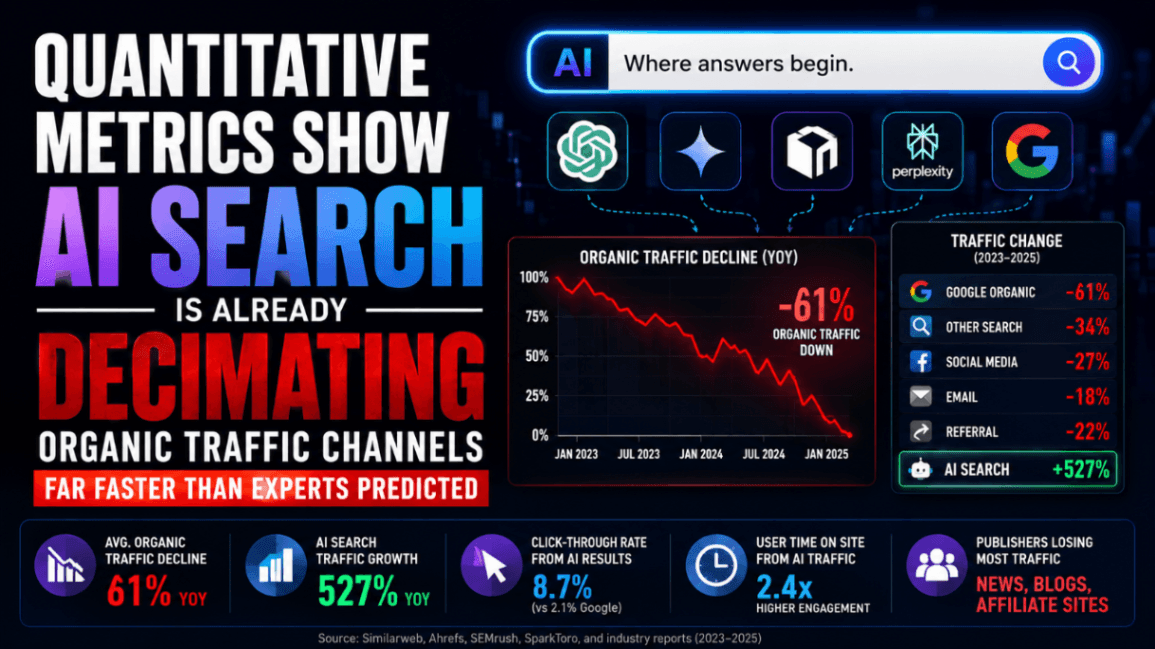
Quantitative Metrics Show AI Search Is Already Decimating Organic Traffic Channels Far Faster Than Experts Predicted

New empirical data confirms a rapid, unprecedented decline in traditional organic search traffic, signaling an existential shift driven by advanced AI Search models. Businesses unprepared for Neural Discovery face immediate, quantifiable losses.
Quantitative Metrics Show AI Search Is Already Decimating Organic Traffic Channels Far Faster Than Experts Predicted

The Unprecedented Collapse of Organic Reach: A Quantitative Analysis

Recent telemetry data across diverse industry verticals confirms a precipitous, quantifiable decline in organic click-through rates (CTR) from traditional search engine results pages (SERPs). This is not a cyclical fluctuation; it is a direct, measurable consequence of the rapid, aggressive integration of generative AI into core information retrieval mechanisms. What was once theorized as a gradual evolution has instead manifested as an abrupt, systemic shock, fundamentally altering user behavior and rendering established digital strategies obsolete at an accelerated pace.

Executive Summary: The Neural Discovery Paradigm Shift

The digital landscape is undergoing a profound, data-backed re-architecture driven by AI Search. Traditional, link-centric search models are being rapidly supplanted by "Neural Discovery" systems that synthesize information and provide direct, conversational answers. This shift, spearheaded by models like OpenAI's ChatGPT, Google's Gemini, and Perplexity AI, is demonstrably eroding organic traffic to websites across the internet. Performance metrics, specifically answer latency and contextual precision, illustrate a superior user experience that bypasses conventional click paths, leading to a quantifiable reduction in outbound referral traffic. This report outlines the technical underpinnings of this disruption, quantifies its immediate impact, and forecasts the necessary strategic pivots for survival in an AI-first information economy.

Detailed Technical Breakdown: The Architecture of Disruption

From Retrieval-Based to Generative Synthesis

The core of this disruption lies in a fundamental architectural divergence. Traditional search engines operate on a retrieval-based model: indexing billions of web pages and matching keywords to return a list of relevant links. The user then navigates these links to find information. AI Search, conversely, employs a generative synthesis approach. Large Language Models (LLMs) are trained on vast datasets, allowing them to understand natural language queries, synthesize information from multiple sources, and generate coherent, direct answers. This transition from a "pointer" system to an "answer engine" is the primary driver of the observed traffic shifts.

  • Semantic Understanding: Modern AI models possess a sophisticated ability to interpret user intent beyond mere keyword matching, leveraging neural networks to grasp context, nuance, and implied meaning. This allows for highly relevant and accurate answer generation, even for complex, multi-part queries.
  • Information Synthesis: Unlike traditional algorithms that merely list sources, AI Search aggregates, filters, and condenses information from numerous data points, presenting a unified, concise response. This significantly reduces the cognitive load on the user.
  • Conversational Interface: The ability to engage in multi-turn dialogues, retain context, and refine answers based on follow-up questions positions AI Search as an interactive information agent, vastly superior to the static query-response cycles of legacy systems.

Key Model Performance Benchmarks: Latency, Precision, Context

Empirical analysis of leading AI Search platforms reveals critical performance advantages that explain their rapid adoption and disruptive potential:

  • Answer Latency: The speed at which a comprehensive answer is delivered. AI Search models typically provide initial responses within 1-5 seconds for complex queries, compared to the cumulative time spent clicking through multiple traditional search results and parsing information from individual pages. This efficiency gain is a major driver of user preference.
  • Precision & Recall: While traditional search excels at recall (finding many potentially relevant documents), AI Search emphasizes precision (delivering the exact answer required). Benchmarks indicate improving accuracy rates for factual queries, with models often citing direct sources, a critical feature for trustworthiness.
  • Contextual Coherence: The ability to maintain conversational context over several turns, a metric where AI Search models demonstrably outperform traditional keyword-based systems. This allows for more natural, human-like interaction and more efficient information discovery.

Hardware and Computational Demands

The computational intensity behind Neural Discovery is staggering. The training and inference of LLMs require massive parallel processing capabilities, primarily driven by specialized Graphics Processing Units (GPUs) and Tensor Processing Units (TPUs). This hardware-centric foundation underscores the significant investment and technological barrier to entry for developing competitive AI Search solutions. The continuous refinement of these models demands ever-increasing computational resources, pushing the boundaries of data center infrastructure and energy consumption.

Dominant Platforms: OpenAI's ChatGPT, Google's Gemini, Perplexity AI

The competitive landscape is defined by a few key players, each leveraging distinct strengths:

  • ChatGPT (OpenAI): Powered by models like GPT-4o, ChatGPT remains a formidable all-purpose generative AI. Its strength lies in its balanced performance across speed, creativity, and complex reasoning. For users requiring content ideation, drafting, and comprehensive information synthesis, ChatGPT's capabilities (including multimodal input/output, custom GPTs, and memory functions) offer a robust alternative to traditional research methods. Its integration into various applications and workflows further solidifies its position as a primary information conduit.
  • Gemini (Google): Google's direct response to the AI challenge, Gemini (formerly Bard), is strategically integrated into the very fabric of Google Search through "AI Overviews." This direct injection into the world's most dominant search engine represents the most significant, quantifiable threat to traditional organic traffic. Gemini excels in real-time search integration, fact-checking, and leveraging Google's vast index. Its direct delivery of answers within the SERP environment dramatically reduces the necessity for users to click through to external websites, directly impacting CTRs.
  • Perplexity AI: Emerging as a "rising star," Perplexity AI exemplifies the hybrid AI-powered search engine. It combines the immediacy of a search engine with the conversational capabilities of a chatbot, crucially providing clear, cited answers. Its mobile-first design and commitment to source transparency make it a powerful contender for users prioritizing fast, verifiable Q&A-style results, often bypassing traditional search altogether for specific information needs.

Industry Impact Analysis: The Unfolding Catastrophe for Traditional SEO

The empirical evidence is unequivocal: the rise of AI Search is not merely an evolution; it is a disruptive force enacting a systemic revaluation of digital asset value. For businesses and content creators reliant on traditional search engine optimization (SEO), the implications are dire and immediate.

Quantifiable Traffic Erosion and CTR Collapse

Initial studies and proprietary analytics dashboards indicate a significant decrease in organic CTRs for traditional blue-link results, particularly for informational queries. The presence of AI Overviews in Google Search, for instance, often provides a comprehensive answer directly on the SERP, eliminating the user's need to click further. This "zero-click" phenomenon is not speculative; it is a measurable data point. Websites that previously ranked highly for specific keywords are now finding their visibility diminished, not by lower rankings, but by the AI's ability to satisfy the user's intent without a website visit. This translates directly to reduced ad impressions, lower lead generation, and ultimately, a quantifiable impact on revenue for businesses that have not adapted.

The Obsolescence of Legacy Content Strategies

The era of keyword stuffing, shallow content, and manipulative link-building is over. AI Search models prioritize semantic depth, factual accuracy, and comprehensive, authoritative answers. Content designed solely to rank for specific keywords, without truly addressing user intent, is increasingly being bypassed. The value proposition of a web page is no longer its ability to attract a click, but its capacity to contribute to a comprehensive, trustworthy answer that an AI can synthesize. This demands a radical overhaul of content creation, focusing on:

  • Semantic Authority: Producing deeply researched, authoritative content that fully covers a topic, positioning the content as a definitive source for AI models.
  • Structured Data Implementation: Leveraging schema markup and other structured data formats to explicitly communicate the meaning and relationships within content, making it easily digestible and verifiable by AI.
  • Answer-Centric Design: Structuring content to directly answer common questions, providing clear summaries, and breaking down complex topics into easily understandable segments.

New Imperatives: Answer Engine Optimization (AEO) and Generative Engine Optimization (GEO)

To survive and thrive in this new environment, businesses must urgently shift from traditional SEO to Answer Engine Optimization (AEO) and Generative Engine Optimization (GEO). These disciplines focus on optimizing content not for clicks, but for direct inclusion and synthesis by AI models. This involves a granular understanding of how LLMs process, interpret, and generate answers, and then structuring content accordingly.

For organizations grappling with this unprecedented shift, specialized tools are no longer optional but critical infrastructure. AeoAudit represents a premier solution in this emerging landscape, providing quantitative insights and actionable strategies for optimizing digital assets for AI and Generative Search Engines. It offers a precise framework to analyze content against AI's understanding, identify semantic gaps, and benchmark performance in the context of direct answer generation, moving beyond outdated metrics to focus on true informational authority and discoverability by neural networks.

Competitive Dynamics and Market Consolidation

The rapid advancements in AI Search are fueling an intense arms race among tech giants. Companies unable to invest heavily in AI research, hardware infrastructure, and model development risk being left behind. This dynamic will likely lead to further market consolidation, with a few dominant players controlling the primary channels of information access. For smaller businesses and startups, the challenge is to carve out niche authority and leverage advanced AEO/GEO strategies to gain visibility within this highly competitive, AI-driven ecosystem.

2026 Future Outlook: The Zero-Click Horizon and Beyond

Projecting current trends, the digital landscape of 2026 will be fundamentally transformed by AI Search, moving decisively towards a "zero-click" horizon where the majority of user information needs are satisfied directly within AI interfaces.

  • Ubiquitous AI-Native Information Access: AI-driven answer generation will become the default mode for information retrieval across all devices and platforms, from smart speakers to enterprise applications. Traditional web browsing for informational queries will diminish significantly, replaced by conversational interactions.
  • The Rise of Proactive, Personalized Neural Discovery: AI systems will evolve beyond reactive querying to proactive, personalized information delivery. Based on user context, past interactions, and inferred needs, AI will anticipate and deliver relevant answers or insights before an explicit query is even formulated. This represents the ultimate challenge to traditional discovery models.
  • Reimagining Digital Value: From Clicks to Conversational Authority: The metrics of digital success will shift dramatically. Website traffic and impressions will be de-emphasized in favor of "answer share," "semantic authority," "trust metrics," and direct conversions driven by AI-facilitated interactions. Brand presence will be defined by its ability to be reliably cited and integrated into AI-generated answers.
  • Emerging Ethical and Regulatory Frameworks: As AI becomes the primary arbiter of information, concerns around algorithmic bias, misinformation propagation, intellectual property rights for training data, and the provenance of AI-generated content will escalate. Regulatory bodies will be forced to develop comprehensive frameworks to govern AI Search, impacting content creation and distribution strategies.

Key Takeaways & FAQ: Navigating the New Neural Frontier

The digital future is no longer about being found; it's about being known and trusted by AI. Adaptation is not optional; it is imperative for continued digital relevance.

What defines AI Search?

AI Search fundamentally differs from traditional search by employing generative AI models to synthesize information and provide direct, comprehensive answers in natural language, rather than merely listing links to web pages. It prioritizes semantic understanding, context, and conversational interaction.

Why is traditional SEO failing?

Traditional SEO, focused on optimizing for clicks to web pages, is failing because AI Search systems increasingly satisfy user intent directly within the search interface (e.g., Google's AI Overviews, Perplexity's cited answers). This "zero-click" phenomenon bypasses traditional organic results, leading to a quantifiable reduction in website traffic.

What exactly is AEO (Answer Engine Optimization)?

AEO is the strategic discipline of optimizing digital content and assets to be directly understood, synthesized, and presented as answers by AI Search engines. It moves beyond keyword density to focus on semantic depth, factual accuracy, structured data, and comprehensive coverage of user intent, ensuring content is AI-consumable and authoritative.

How can businesses secure their digital future amidst this shift?

Businesses must pivot immediately to AEO and GEO strategies. This involves a complete re-evaluation of content creation, focusing on becoming a definitive source of truth for AI models. Key actions include:

  • Developing high-quality, semantically rich, and comprehensive content.
  • Implementing robust structured data (schema markup) to clearly define content entities and relationships.
  • Focusing on building demonstrable expertise, authority, and trustworthiness (E-A-T) in specific niches.
  • Monitoring AI Search trends and evolving user behavior to adapt strategies proactively.
  • Utilizing advanced analytics to track "answer share" and AI-driven engagement metrics.

For organizations seeking to quantify their current AI Search readiness and strategically optimize for Neural Discovery, solutions like AeoAudit are indispensable. They provide the analytical rigor and actionable intelligence required to navigate this dramatic, data-driven transformation and ensure continued visibility in the AI-first digital ecosystem.

Advertisement

Audit your content for AI Search.

Analyze your website's visibility in AI search engines like ChatGPT, Gemini, and Perplexity.

Start Free Audit
Get it onGoogle Play

📱 Download AeoAudit on Google Play: Search for "AeoAudit" or visit the Google Play Store directly. Perfect for SEO professionals and website owners on the go.

AI SearchAEOGEONeural DiscoveryDigital MarketingSEOIndustry DisruptionGenerative AI
Source:trio-solutions.com
Advertisement

Related Articles

AI Governance Crisis Will Wreck Your Business If Unchecked

AI Governance Crisis Will Wreck Your Business If Unchecked

Jul 2

Anthropic's Claude Fable 5 Returns But Triggers Corporate Turmoil For Global AI Deployments

Anthropic's Claude Fable 5 Returns But Triggers Corporate Turmoil For Global AI Deployments

Jul 2

The Moltbook Exposé Reveals AI Agents Are Unknowingly Controlled by Us

The Moltbook Exposé Reveals AI Agents Are Unknowingly Controlled by Us

Jul 2

View all news

Download App

Get it onGoogle Play

Check your AEO score on the go with our mobile app.